2026 Congressional Act: Retirement Benefits Reshaped

The 2026 Congressional Act fundamentally alters retirement benefits for 30 million Americans, implementing critical reforms to enhance financial stability for future generations.
Breaking News: Congressional Act of 2026 Reshapes Retirement Benefits for 30 Million Americans marks a pivotal moment for financial planning across the United States. This legislative overhaul is poised to redefine how millions approach their golden years, demanding immediate attention and careful consideration.
Understanding the core changes in the 2026 Congressional Act
The 2026 Congressional Act introduces a series of profound adjustments to the existing retirement benefits framework. These changes are not merely incremental; they represent a significant recalibration designed to address long-term sustainability and equitable distribution of resources. For 30 million Americans, this means a direct impact on their projected retirement income and planning strategies.
At its heart, the act aims to fortify the solvency of critical retirement programs while adapting to evolving demographic and economic landscapes. It’s a complex piece of legislation with various provisions targeting different aspects of retirement savings and disbursements.
Key pillars of the new legislation
- Increased contribution limits: The act raises the maximum allowable contributions to 401(k)s and IRAs, providing individuals with greater capacity to save for retirement on a tax-advantaged basis. This is a direct response to rising living costs and extended life expectancies.
- Adjustments to eligibility age: For certain benefits, the full retirement age will gradually increase for younger generations, reflecting shifts in life expectancy and workforce participation. This aims to ensure the long-term viability of the system.
- Enhanced protection for vulnerable populations: New clauses are introduced to offer additional support and safeguards for low-income retirees and those with specific health challenges, ensuring a basic safety net remains robust.
The implications of these core changes extend far beyond simple numbers. They necessitate a re-evaluation of personal financial strategies, urging individuals to consult with financial advisors and understand how these new rules apply to their specific situations. The government’s intent is to create a more resilient system, but individual adaptation is key.
Impact on current retirees and near-retirees
For the millions of Americans already in retirement or on the cusp of it, the 2026 Congressional Act brings both clarity and potential adjustments. While the act primarily targets future sustainability, certain provisions will have immediate effects on those currently receiving benefits or planning to claim them soon. Understanding these nuances is crucial for maintaining financial stability and peace of mind.
The legislation seeks to avoid abrupt disruptions for existing retirees, often phasing in changes over several years. However, specific clauses related to cost-of-living adjustments (COLAs) and taxation of benefits might see minor shifts, requiring careful monitoring by beneficiaries.
Navigating benefit adjustments
Many individuals nearing retirement are concerned about how their projected benefits might change. The act addresses this by providing clear guidelines on how existing benefit formulas will be treated, often grandfathering in certain rules for those closest to retirement. This approach aims to minimize uncertainty and allow for informed decision-making during a critical life stage.
- Cost-of-living adjustments (COLAs): The method for calculating COLAs may be refined to better reflect actual inflation rates experienced by seniors, potentially leading to more accurate benefit increases over time.
- Taxation thresholds: Some adjustments to income thresholds for taxing Social Security benefits are anticipated, which could impact a segment of higher-income retirees.
- Spousal and survivor benefits: The act reinforces protections and clarifies rules for spousal and survivor benefits, ensuring that dependents are adequately covered in unforeseen circumstances.
Near-retirees are encouraged to review their Social Security statements and pension plans in light of these new regulations. Proactive planning, including potential adjustments to withdrawal strategies or part-time work, could mitigate any perceived negative impacts and optimize their financial outlook under the new framework.
Future implications for younger generations and long-term planning
While the immediate focus often falls on those nearing retirement, the 2026 Congressional Act holds particularly significant implications for younger generations. These reforms are fundamentally designed to secure the long-term viability of retirement systems, meaning today’s workers will experience the most pronounced effects over their careers. Understanding these future implications is vital for effective long-term financial planning.
The act introduces mechanisms to ensure that the system remains solvent for decades to come, moving away from short-term fixes towards a more sustainable model. This foresight is crucial given changing demographics, including increased life expectancies and fluctuating birth rates.
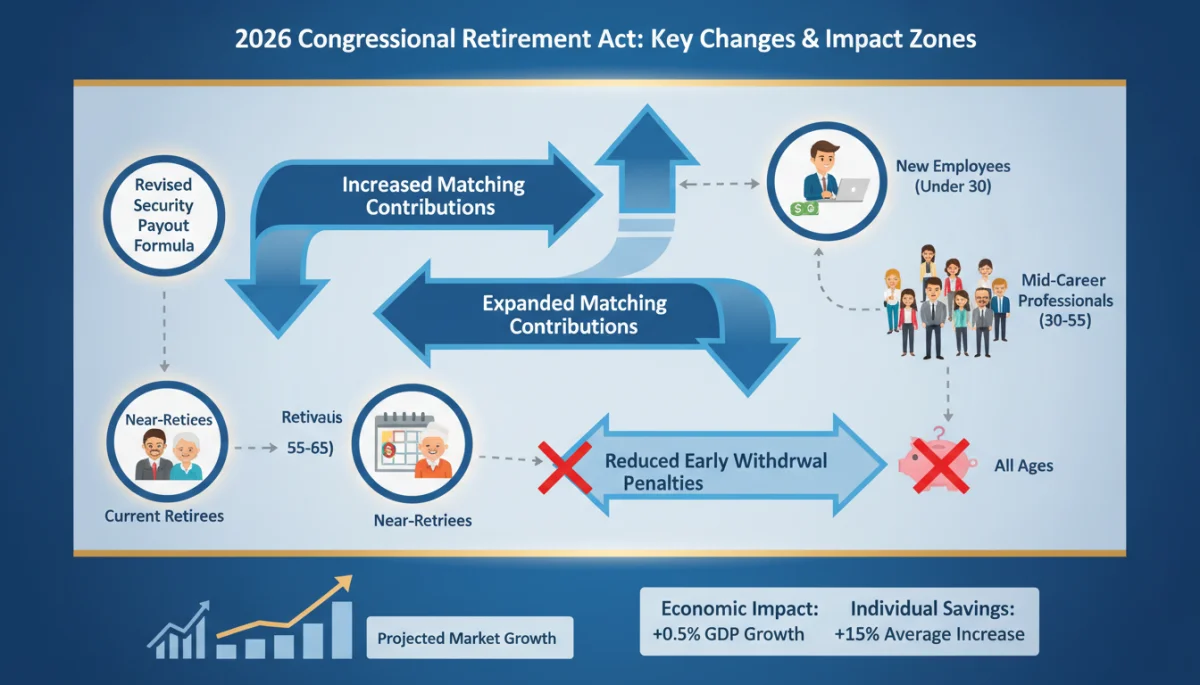
Future workers will encounter adjusted eligibility criteria and potentially different benefit calculation methods. These changes are not intended to diminish future benefits but rather to ensure that the promise of retirement security can be met for all generations.
Adapting to a new retirement landscape
For those just starting their careers or in their early working years, the act underscores the importance of personal savings and diversified investment strategies. The emphasis on individual responsibility within a strengthened public system becomes even more pronounced.
- Increased personal savings incentives: The higher contribution limits for retirement accounts directly encourage younger individuals to save more aggressively from an earlier age, leveraging the power of compound interest.
- Financial literacy initiatives: The act may spur greater investment in financial literacy programs, helping younger generations navigate complex retirement planning decisions.
- Flexibility in career paths: With potential adjustments to full retirement age, individuals might consider more flexible career trajectories, including phased retirement or continued part-time work.
The long-term success of the 2026 Congressional Act hinges on both the robustness of its design and the ability of individuals, particularly younger ones, to adapt their financial behaviors. Early engagement with retirement planning tools and professional advice will be more critical than ever.
The role of personal savings and investment strategies
In the wake of the 2026 Congressional Act, the importance of personal savings and robust investment strategies cannot be overstated. While the act aims to stabilize federal retirement programs, it simultaneously reinforces the necessity for individuals to take a proactive role in securing their financial future. This dual approach emphasizes that government benefits are a foundation, not the sole pillar, of a comfortable retirement.
The new legislation, with its adjusted contribution limits and eligibility criteria, serves as a clear signal for Americans to maximize their private retirement accounts. Diversifying investments and understanding risk tolerance become paramount in this evolving landscape.
Optimizing your financial portfolio
Effective personal savings involve more than just contributing to a 401(k) or IRA; it requires a strategic approach to investment. This includes understanding different asset classes, market trends, and long-term growth potential. Financial advisors play a crucial role in helping individuals tailor strategies to their unique circumstances and goals.
- Maxing out retirement accounts: Utilizing the increased contribution limits for 401(k)s, IRAs, and HSAs (Health Savings Accounts) is a smart move, offering tax advantages and significant growth potential over time.
- Diversifying investments: Spreading investments across various asset classes like stocks, bonds, and real estate can mitigate risk and enhance long-term returns, crucial for enduring market fluctuations.
- Regular review and adjustment: Periodically reviewing and adjusting investment portfolios to align with life changes, market conditions, and legislative updates ensures that one’s financial plan remains on track.
Ultimately, the 2026 Congressional Act empowers individuals by providing a clearer framework within which to build their retirement wealth. It’s an invitation to engage more deeply with personal finance and leverage available tools to achieve financial independence.
Potential economic and societal ripple effects
The 2026 Congressional Act, designed to reshape retirement benefits for 30 million Americans, is not merely a financial adjustment; it’s a legislative earthquake with potential economic and societal ripple effects that will resonate across the nation. Understanding these broader implications is crucial for policymakers, businesses, and individuals alike, as they will influence everything from consumer spending to workforce dynamics.
Economically, the act could stimulate certain sectors while potentially dampening others. Changes in retiree spending patterns, driven by adjusted benefits, will inevitably impact various industries. Socially, the act may influence retirement ages, family support structures, and even migration patterns as individuals seek optimal living conditions in their later years.
Broader impacts on the national landscape
The act’s emphasis on long-term sustainability could lead to greater confidence in the national economy, potentially encouraging more investment and stability. However, the adjustments to eligibility and benefit calculations might also create new challenges for certain demographics, requiring complementary social support programs.
- Workforce participation: A potential increase in the full retirement age could lead to older Americans remaining in the workforce longer, impacting labor markets and creating new demands for flexible work arrangements.
- Healthcare demands: With potentially longer working lives and extended retirements, the demand for accessible and affordable healthcare services for seniors will likely intensify, putting pressure on existing systems.
- Consumer spending patterns: Changes in discretionary income for retirees could shift consumer spending, affecting sectors reliant on senior demographics, such as leisure, travel, and specialized goods and services.
The 2026 Congressional Act sets a precedent for how a nation addresses its aging population and long-term financial commitments. Its success will be measured not only by its immediate financial impacts but also by its ability to foster a more secure and adaptable society for all.
Expert opinions and public reception
The introduction of the 2026 Congressional Act has naturally sparked a wide array of expert opinions and a varied public reception. Financial analysts, economists, and social policy experts are dissecting its provisions, offering insights into its potential strengths and weaknesses. Meanwhile, the public, particularly the 30 million Americans directly affected, is reacting with a mix of optimism, concern, and a desire for clarity.
Many experts commend the act for its proactive approach to ensuring the long-term solvency of retirement programs, a challenge that has loomed for decades. They highlight the necessity of such reforms in the face of an aging population and changing economic realities. However, critics often point to potential burdens on younger generations or perceived inadequacies in supporting the most vulnerable.
Diverse perspectives on the legislation
Public reception has been equally complex. While some welcome the legislative action as a necessary step towards securing future benefits, others express apprehension about how the changes will personally affect their retirement plans. Advocacy groups for seniors and workers are actively engaging in discussions, advocating for their constituents’ interests.
- Economists’ views: Many economists see the act as a crucial step towards fiscal responsibility, emphasizing its role in reducing future deficits and stabilizing key entitlement programs.
- Social policy advocates: These groups often focus on the equity aspects, ensuring that reforms do not disproportionately impact low-income individuals or those with limited access to private savings.
- Individual concerns: On a personal level, many Americans are seeking detailed information and personalized advice to understand how the act will specifically alter their retirement trajectory.
The ongoing dialogue between experts, policymakers, and the public is vital as the nation adjusts to this new legislative reality. Continued education and transparent communication will be key to fostering understanding and ensuring a smooth transition for all affected by the 2026 Congressional Act.
| Key Aspect | Brief Description |
|---|---|
| Contribution Limits | Increased limits for 401(k)s and IRAs, promoting greater personal savings. |
| Eligibility Age | Gradual increase in full retirement age for younger generations. |
| Current Retirees | Phased-in changes with minimal abrupt disruptions to existing benefits. |
| Long-Term Solvency | Aims to secure retirement programs for future generations. |
Frequently asked questions about the 2026 Congressional Act
The act directly affects over 30 million Americans, including current retirees, near-retirees, and younger generations, through changes in contribution limits, eligibility ages, and benefit calculations.
For current retirees, changes are generally phased in to minimize disruption. While direct benefit amounts may see minor adjustments, the act primarily focuses on long-term sustainability rather than immediate cuts for existing beneficiaries.
The act increases maximum allowable contributions to 401(k)s and IRAs. Specific figures will be detailed in the official regulations, providing individuals greater capacity for tax-advantaged retirement savings.
Younger generations will experience gradual increases in the full retirement age and an enhanced focus on personal savings, ensuring the long-term solvency of the system for their future benefits.
It is highly recommended to consult with a qualified financial advisor who can assess your individual situation and provide tailored guidance on how the 2026 Congressional Act impacts your specific retirement plan.
Conclusion
The 2026 Congressional Act represents a landmark effort to secure the future of retirement benefits for millions of Americans. By addressing long-standing challenges and introducing forward-thinking reforms, the legislation aims to create a more stable and sustainable system for generations to come. While the changes necessitate a careful review of personal financial strategies, the act ultimately reinforces the importance of proactive planning and informed decision-making in navigating the evolving landscape of retirement in the United States.