2026 SAT/ACT Prep: Boost Your Score by 15% with Key Techniques

Preparing for the 2026 SAT/ACT demands a structured approach, integrating essential study techniques to achieve a significant 15% score increase for competitive college applications.
As the academic landscape evolves, students aiming for higher education in the United States face the perennial challenge of standardized tests. Preparing for the 2026 SAT/ACT: Essential Study Techniques for a 15% Score Increase is not merely about diligent studying; it’s about smart, strategic preparation. This comprehensive guide will equip you with the insights and methods necessary to not only meet but exceed your target scores, paving the way for your academic future.
Understanding the 2026 SAT and ACT Landscape
The 2026 SAT and ACT exams continue to be pivotal components of college admissions, though their formats and emphasis may see subtle shifts. Recognizing these nuances is the first step towards effective preparation. Both tests assess critical thinking, problem-solving, and academic readiness, but they do so through different lenses and structures, making it vital to understand their specific demands.
Staying informed about any potential changes to test content or administration is crucial. Official College Board and ACT websites are your primary sources for the most up-to-date information, ensuring your study plan aligns with the current exam specifications. This proactive approach prevents wasted effort and focuses your energy on what truly matters for your score improvement.
Key Differences and Similarities
While both tests aim to evaluate college readiness, they have distinct characteristics. The SAT, for instance, has transitioned to a digital format, emphasizing critical reading and math. The ACT, on the other hand, includes a science section and typically features more straightforward questions but requires faster pacing.
- Digital SAT: Adaptive testing, shorter duration, integrated calculator for math.
- ACT: Science reasoning section, more direct questions, time-management intensive.
- Similarities: Both assess English, Reading, and Math skills; both are scored on a scaled system.
Ultimately, choosing between the SAT and ACT, or deciding to take both, depends on your individual strengths and the requirements of your target universities. A diagnostic test for each can provide valuable insight into which format suits your learning style and cognitive approach best, serving as a baseline for your 2026 SAT/ACT preparation journey.
Setting Realistic Score Goals and a Strategic Timeline
Achieving a 15% score increase on the SAT or ACT is an ambitious yet attainable goal, provided you establish realistic targets and a well-structured timeline. This involves understanding your current baseline, researching target university requirements, and breaking down your overall objective into manageable, incremental steps. Without clear goals, your preparation can lack direction and efficiency.
Begin by taking a full-length diagnostic test for your chosen exam(s). This will give you an accurate starting point and highlight areas of weakness and strength. With this baseline, you can then identify specific sub-scores that need the most attention. Many colleges publish their average admitted student scores, which can guide your target score range.
Crafting Your Personalized Study Schedule
A strategic timeline is the backbone of successful preparation. Ideally, you should dedicate several months to consistent study, allowing ample time for content review, practice, and refinement. Avoid cramming, as it rarely leads to sustainable score improvements.
- Early Start: Begin 4-6 months before your first test date.
- Consistent Practice: Dedicate 2-4 hours per week to focused study sessions.
- Scheduled Breaks: Integrate rest days to prevent burnout and consolidate learning.
- Review and Adapt: Regularly assess your progress and adjust your schedule as needed.
Your study schedule should be flexible enough to accommodate schoolwork and extracurricular activities, yet firm enough to ensure consistent progress. Remember that the goal is not just to study, but to study effectively, making every hour count towards your 2026 SAT/ACT score increase.
Mastering Content: Targeted Review and Active Learning
Simply reviewing textbooks is often insufficient for significant score gains. To truly excel, you must engage in targeted content review combined with active learning strategies. This approach ensures that you not only understand the material but can also apply it effectively under test conditions. Identifying your knowledge gaps is paramount before diving into extensive review.
Utilize official study guides and reputable online resources that align with the 2026 test specifications. Focus on areas where your diagnostic test revealed weaknesses. For example, if algebra is a struggle, dedicate more time to algebraic concepts and practice problems. Don’t just passively read; actively engage with the material.
Effective Active Learning Techniques
Active learning transforms passive consumption into meaningful engagement, leading to better retention and understanding. These techniques force your brain to work harder, creating stronger neural connections and improving recall during the actual exam.
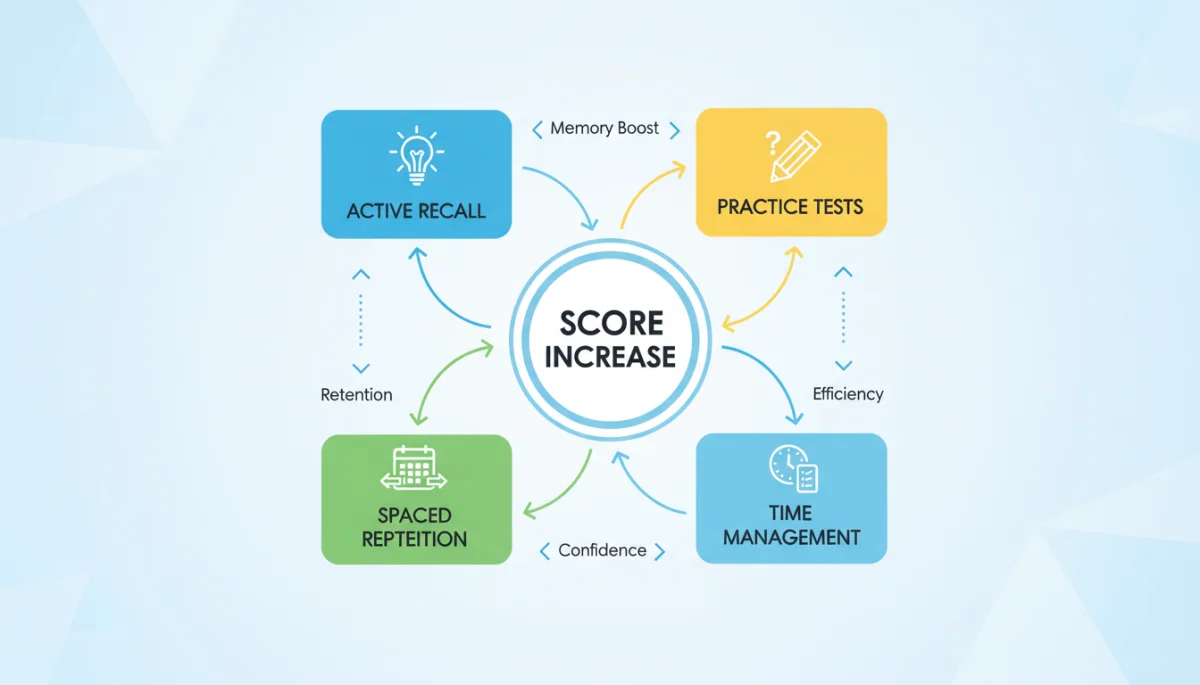
- Active Recall: Instead of re-reading, try to retrieve information from memory. Use flashcards or self-quizzing.
- Spaced Repetition: Review material at increasing intervals to strengthen memory over time.
- Elaboration: Explain concepts in your own words, or teach them to someone else.
- Interleaving: Mix different subjects or topics during study sessions, rather than blocking them.
By integrating these active learning methods into your 2026 SAT/ACT preparation, you’ll build a deeper, more robust understanding of the tested content. This proactive engagement is a critical factor in achieving that desired 15% score improvement, moving beyond rote memorization to true mastery.
Strategic Practice: Full-Length Tests and Error Analysis
Practice tests are indispensable for preparing for the 2026 SAT/ACT, but their value extends beyond merely familiarizing you with the format. Strategic practice involves taking full-length exams under timed conditions, followed by meticulous error analysis. This two-pronged approach not only builds stamina but also pinpoints specific areas for improvement, transforming mistakes into learning opportunities.
Simulate test day conditions as closely as possible. Find a quiet environment, set a timer, and complete each section without interruptions. This helps you build the necessary focus and endurance for the actual exam, reducing anxiety on test day. Treat each practice test as a dress rehearsal, allowing you to fine-tune your pacing and approach.
The Power of Error Analysis
After each practice test, dedicate significant time to reviewing every question, especially those you answered incorrectly or guessed on. Understanding why you made a mistake is more important than simply knowing the correct answer. Was it a content gap, a misinterpretation of the question, or a time management issue?
- Categorize Errors: Group mistakes by subject, question type, or error pattern.
- Understand the Reasoning: For each incorrect answer, identify the correct reasoning and why your initial thought was wrong.
- Revise Strategies: Adjust your approach for similar questions in the future.
- Track Progress: Maintain an error log to observe recurring patterns and ensure you’re not making the same mistakes.
This systematic error analysis is a cornerstone of effective 2026 SAT/ACT preparation. It allows you to transform each practice session into a targeted learning experience, directly contributing to your goal of a 15% score increase by addressing your specific weaknesses.
Optimizing Test-Taking Strategies and Time Management
Beyond content knowledge, excelling on the SAT and ACT demands mastery of test-taking strategies and impeccable time management. These exams are as much about how you approach the questions as they are about what you know. Developing efficient strategies can help you maximize your score even when faced with challenging problems or tight deadlines.
Each section of the SAT and ACT has its unique timing constraints and question types. Familiarize yourself with these specifics. For instance, the ACT often requires quicker responses per question, while the SAT might have fewer questions but they demand more intensive analysis. Knowing these differences allows you to tailor your approach section by section.
Key Strategies for Each Section
Developing specific strategies for each section can significantly improve your efficiency and accuracy. This includes understanding when to guess, when to skip, and how to eliminate incorrect answer choices effectively.
- Reading: Practice active reading, identifying main ideas and supporting details quickly.
- Writing/English: Focus on grammar rules, punctuation, and sentence structure.
- Math: Master calculator usage (SAT) or mental math (ACT), and understand common problem types.
- Science (ACT): Learn to quickly interpret graphs, tables, and experimental data.
Effective time management means allocating your time wisely across all questions, ensuring you don’t get stuck on one problem for too long. Practice pacing yourself during full-length tests and adjust your speed based on the difficulty of the questions. These refined test-taking strategies are vital for securing a substantial 15% score increase on the 2026 SAT/ACT.
Maintaining Well-being and Mental Preparedness
While academic preparation is crucial, your mental and physical well-being play an equally significant role in your 2026 SAT/ACT performance. Stress, anxiety, and fatigue can severely impair cognitive function, undermining even the most diligent study efforts. A holistic approach that includes self-care is essential for peak performance on test day.
Prioritize adequate sleep, especially in the weeks leading up to the exam. A well-rested mind is better equipped to focus, recall information, and solve complex problems. Maintain a balanced diet, incorporating foods that fuel your brain and body, and stay hydrated throughout the day. These basic habits form the foundation of mental resilience.
Strategies for Stress Reduction and Focus
Managing test anxiety is a common challenge for many students. Incorporating stress-reduction techniques into your routine can help you stay calm and focused, both during your preparation and on the actual test day.
- Mindfulness and Meditation: Short daily sessions can improve focus and reduce anxiety.
- Physical Activity: Regular exercise is a proven stress reliever and boosts cognitive function.
- Breathing Exercises: Simple deep breathing techniques can calm nerves during high-pressure moments.
- Positive Affirmations: Counter negative thoughts with positive self-talk to build confidence.
By consciously nurturing your well-being, you create an optimal state for learning and performance. Remember, preparing for the 2026 SAT/ACT: Essential Study Techniques for a 15% Score Increase isn’t just about what you study, but how you prepare yourself mentally and physically to tackle the challenge successfully. A calm and confident mindset can make all the difference in achieving your target score.
| Key Technique | Brief Description |
|---|---|
| Targeted Content Review | Focus on specific weak areas identified by diagnostic tests. |
| Active Learning | Employ methods like active recall and spaced repetition for retention. |
| Error Analysis | Systematically review mistakes from practice tests to learn and improve. |
| Time Management | Develop efficient pacing and strategic approaches for each test section. |
Frequently Asked Questions About 2026 SAT/ACT Prep
The SAT has transitioned to a fully digital, adaptive format, which is shorter and allows for calculator use on all math sections. The ACT generally maintains its paper-based format with a science section, emphasizing quick problem-solving. Always check official sources for the latest updates.
For a 15% score increase, a consistent study schedule of 2-4 hours per week over 4-6 months is recommended. This allows for thorough content review, practice tests, and error analysis without burnout, ensuring deep learning and retention.
The choice depends on your individual strengths. Take a diagnostic test for both to see which format aligns better with your skills and preferred test-taking style. Some students perform better on one over the other due to structural differences.
Practice tests are crucial for building stamina, familiarizing yourself with the format, and identifying weaknesses. More importantly, detailed error analysis after each test helps pinpoint specific areas for improvement, transforming mistakes into learning opportunities for substantial score gains.
Incorporate stress-reduction techniques like mindfulness, regular exercise, and deep breathing exercises into your routine. Prioritize adequate sleep and a healthy diet. A calm and confident mindset is as vital as academic preparation for optimal performance on the 2026 SAT/ACT.
Conclusion
Achieving a significant score increase on the 2026 SAT/ACT is a challenging yet entirely achievable goal with the right approach. By embracing targeted content review, active learning, strategic practice, and meticulous error analysis, students can systematically strengthen their academic foundations. Furthermore, optimizing test-taking strategies and prioritizing mental and physical well-being are indispensable elements of a comprehensive preparation plan. Remember, success on these exams is a marathon, not a sprint, requiring consistent effort and smart strategies. With dedication to these essential study techniques, students are well-positioned to not only meet but exceed their score expectations, opening doors to their desired higher education opportunities and securing a brighter future.