Choosing the Right Online Degree Program in 2026: 5 Options
Choosing the right online degree program in 2026 demands a meticulous comparative analysis, focusing on accreditation, curriculum, flexibility, cost, and career prospects to ensure alignment with personal and professional aspirations.
In an increasingly digital world, the landscape of higher education has undergone a profound transformation. For prospective students in 2026, the decision of choosing the right online degree program is more critical and complex than ever. This comprehensive guide will navigate you through a comparative analysis of five prominent online degree options, helping you make an informed choice that aligns with your academic ambitions and career trajectory.
The evolving landscape of online education in 2026
Online education has moved beyond its early experimental stages to become a sophisticated and highly respected mode of learning. In 2026, technological advancements and pedagogical innovations have created an environment where virtual classrooms are as rigorous and engaging as their traditional counterparts, often offering unparalleled flexibility.
Understanding this evolution is crucial. The quality of online programs varies significantly, and what might have been considered a niche option a decade ago is now a mainstream pathway for millions. This shift necessitates a deeper dive into what makes a program truly stand out in terms of academic excellence, student support, and career integration.
Technological integration and learning platforms
Modern online degree programs leverage cutting-edge technology to enhance the learning experience. This includes interactive virtual labs, AI-powered tutoring, and collaborative tools that foster a sense of community among students.
- Advanced Learning Management Systems (LMS): Platforms like Canvas, Blackboard, and Moodle now integrate AI for personalized learning paths.
- Virtual Reality (VR) and Augmented Reality (AR): Used for immersive simulations in fields like healthcare and engineering.
- Synchronous and Asynchronous Learning: Offering a blend of real-time interaction and self-paced study to suit diverse schedules.
The continuous development of these platforms ensures that students receive a dynamic and interactive educational experience, mimicking or even surpassing traditional classroom engagement. This technological backbone is a cornerstone of effective online learning today.
Ultimately, the strength of an online program often lies in its ability to adapt and integrate these technological innovations seamlessly. Students benefit from environments that are not only accessible but also highly effective in delivering complex educational content and fostering critical thinking skills.
Key considerations for selecting an online degree program
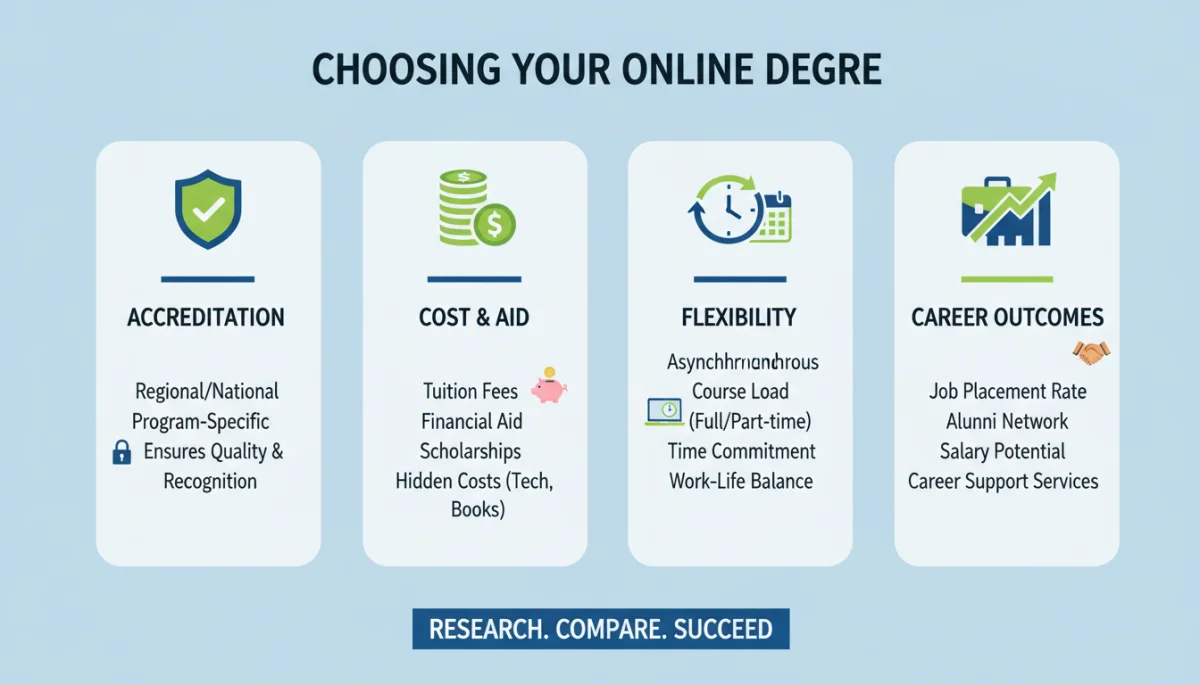
Before diving into specific programs, it’s essential to establish a framework for evaluation. Several critical factors should guide your decision-making process when considering an online degree. These elements collectively determine the value, relevance, and ultimate success of your chosen path.
Ignoring any of these aspects could lead to dissatisfaction or a degree that doesn’t fully meet your expectations. A holistic approach ensures you invest your time and resources wisely into a program that will genuinely propel your career forward.
Accreditation and reputation
Accreditation is non-negotiable. It signifies that a program meets established quality standards and is recognized by employers and other academic institutions. Always verify the accrediting body and its recognition by the Council for Higher Education Accreditation (CHEA) or the U.S. Department of Education.
- Regional vs. National Accreditation: Regional accreditation is generally more prestigious and widely accepted.
- Program-Specific Accreditation: Certain fields (e.g., nursing, engineering) require specialized accreditation for licensure.
- University Reputation: A strong institutional reputation often translates to better career prospects and alumni networks.
A degree from an unaccredited institution can be worthless in the job market and may not be accepted for further education. Therefore, this should be the first criterion you evaluate for any prospective program.
The reputation of the university also plays a significant role. A well-regarded institution not only provides a quality education but also opens doors to valuable networking opportunities and enhances your resume.
Comparative analysis of 5 online degree programs for 2026
To illustrate the breadth of options available, let’s compare five popular online degree programs across different disciplines. This analysis will highlight their unique strengths and target audiences, providing a clearer picture of what to expect.
Each program represents a distinct pathway, catering to various career goals and learning preferences. By examining these examples, you can begin to identify which characteristics are most important for your personal and professional development.
1. Master of Business Administration (MBA) Online
An online MBA remains one of the most sought-after graduate degrees. Programs often emphasize leadership, strategy, and analytical skills, preparing graduates for senior management roles across diverse industries.
- Flexibility: High, with many asynchronous options to accommodate working professionals.
- Curriculum: Core business functions (finance, marketing, operations) with specialization tracks (e.g., healthcare management, technology leadership).
- Career Outlook: Excellent, with strong demand for skilled business leaders.
Top-tier online MBA programs often feature robust career services, executive coaching, and opportunities for global networking. These programs are designed for individuals looking to accelerate their careers or transition into new leadership roles.
The return on investment for a reputable online MBA can be substantial, making it a valuable asset for long-term career growth. However, the cost can be significant, so financial planning is key.
2. Bachelor of Science in Computer Science (BSCS) Online
With the booming tech industry, an online BSCS program is an increasingly popular choice. These programs equip students with foundational knowledge in programming, algorithms, and software development, essential for various tech roles.
- Hands-on Learning: Emphasizes practical projects, coding assignments, and virtual labs.
- Specializations: Data science, cybersecurity, artificial intelligence, software engineering.
- Industry Relevance: Directly prepares students for high-demand roles in tech companies.
Many online BSCS programs are designed to be highly interactive, often incorporating peer programming and collaborative projects. This ensures graduates possess not only theoretical knowledge but also practical, teamwork-oriented skills.
The flexibility of online computer science degrees allows individuals to upskill or reskill without interrupting their current employment, making it an attractive option for career changers and those looking to advance.
3. Master of Science in Nursing (MSN) Online
For registered nurses looking to advance their careers, an online MSN offers pathways to leadership, education, or specialized clinical roles such as Nurse Practitioner (NP). These programs combine advanced theory with clinical practice requirements.
- Clinical Hours: Typically require supervised clinical hours, often completed locally.
- Specialties: Family Nurse Practitioner, Nurse Educator, Nursing Administration, Clinical Nurse Specialist.
- Demand: High, driven by an aging population and healthcare workforce shortages.
Online MSN programs provide the necessary academic rigor and specialized training while allowing nurses to continue working. This balance is crucial for a profession that often requires significant time commitment.
Graduates of online MSN programs are prepared to take on greater responsibilities and leadership roles within the healthcare system, contributing to improved patient outcomes and healthcare delivery.
4. Bachelor of Arts in Psychology Online
An online BA in Psychology is suitable for those interested in human behavior, mental health, or pursuing graduate studies in fields like counseling or social work. These programs offer a broad understanding of psychological principles.
- Foundational Knowledge: Covers cognitive, developmental, social, and abnormal psychology.
- Research Skills: Emphasizes research methods, statistical analysis, and critical thinking.
- Career Paths: Entry-level roles in human resources, social services, marketing, or preparation for graduate school.
Online psychology programs often utilize interactive case studies and virtual discussions to explore complex human behaviors and theories. This fosters a dynamic learning environment despite the online format.
The versatility of a psychology degree makes it a strong foundation for various careers, and the online format provides accessibility for a wide range of students, including those balancing work or family commitments.
5. Master of Public Health (MPH) Online
An online MPH program prepares professionals to address public health challenges, from disease prevention to health policy. It’s ideal for those passionate about community health and global well-being.
- Interdisciplinary Focus: Integrates epidemiology, biostatistics, environmental health, and health policy.
- Real-World Impact: Focuses on practical applications to improve population health outcomes.
- Global Relevance: Addresses pressing health issues at local, national, and international levels.
Online MPH programs often incorporate community-based projects and practicums, allowing students to apply theoretical knowledge to real-world public health initiatives. This experiential learning is invaluable for future public health leaders.
The demand for public health professionals has surged, making an MPH a highly relevant degree for those seeking to make a significant impact on societal health and well-being.
Maximizing your online learning experience
Enrolling in an online degree program is just the first step; maximizing your learning experience requires active participation and strategic planning. Online learning demands self-discipline and effective time management to succeed.
Many students find that developing strong organizational habits and leveraging available resources are key to thriving in a virtual academic environment. It’s about creating a personal learning ecosystem that supports your goals.
Strategies for success in online programs
Successful online students often employ specific strategies to stay engaged and perform well. These strategies range from setting up a dedicated study space to proactive communication with instructors and peers.
- Time Management: Create a consistent study schedule and stick to it.
- Active Participation: Engage in discussion forums, group projects, and virtual office hours.
- Utilize Resources: Access online libraries, tutoring services, and technical support.
- Networking: Connect with classmates and professors; build professional relationships.
Proactive engagement is crucial. Simply logging in and completing assignments is often not enough to fully grasp complex concepts or build valuable connections. Seek out opportunities for deeper interaction and collaboration.
Remember that online learning, while flexible, is not passive. It requires a high level of self-motivation and the ability to adapt to a digital learning environment. Embrace these challenges as opportunities for growth.
Financial aid and return on investment for online degrees
Understanding the financial aspects of an online degree is as important as evaluating its academic merits. While online programs can sometimes be more affordable due to reduced overheads, tuition costs can still be substantial. It’s crucial to explore all available financial aid options and consider the potential return on investment.
Many institutions offer various forms of financial assistance specifically for online students, including scholarships, grants, and federal loans. Researching these options early can significantly impact your ability to pursue higher education without undue financial burden.
Exploring funding opportunities
Don’t assume online degrees are automatically cheaper or that financial aid is limited. Many universities are committed to making online education accessible and provide comprehensive support.
- Federal Student Aid (FAFSA): The primary application for federal grants, loans, and work-study programs.
- University-Specific Scholarships: Many institutions offer scholarships tailored for online students or specific programs.
- Employer Tuition Reimbursement: Check if your employer offers programs to cover educational expenses.
- Private Scholarships and Grants: Seek out external organizations that offer funding based on merit, need, or field of study.
Beyond the initial cost, consider the long-term return on investment (ROI). A degree that leads to significant salary increases or career advancement can quickly justify its expense. Researching average post-graduation salaries for your chosen field and program is a wise step.
Weighing the cost against potential career benefits will help you make a financially sound decision. An investment in a quality online degree can pay dividends for years to come.
| Key Aspect | Brief Description |
|---|---|
| Accreditation | Ensures program quality and recognition for employment or further study. |
| Flexibility | Ability to balance studies with work and personal commitments, crucial for online learners. |
| Career Outlook | Evaluates job market demand and potential salary growth post-graduation. |
| Cost & Aid | Assessment of tuition, fees, and available financial assistance options. |
Frequently asked questions about online degrees
Yes, in 2026, online degrees from accredited institutions are widely respected. Employers increasingly value the skills, flexibility, and self-discipline demonstrated by online graduates, recognizing the rigor and quality of modern virtual programs.
You can verify accreditation through the Council for Higher Education Accreditation (CHEA) or the U.S. Department of Education websites. Always look for regional accreditation, which generally holds more weight and broader recognition.
Typically, you’ll need a reliable computer, stable internet access, a webcam, and a microphone. Some programs may require specific software or hardware, so always check the program’s technical requirements before enrolling.
Absolutely. Most accredited online degree programs are eligible for federal financial aid (FAFSA), as well as institutional scholarships, grants, and private loans. Many employers also offer tuition reimbursement benefits.
The level of flexibility varies. Many programs offer asynchronous learning, allowing you to study on your own schedule. Others include synchronous components like live virtual classes. It’s important to choose a program that fits your lifestyle.
Conclusion
Choosing the right online degree program in 2026 is a significant decision that requires careful thought and thorough research. By considering factors such as accreditation, curriculum relevance, flexibility, cost, and career outcomes, you can confidently select a program that not only meets your academic needs but also propels your professional aspirations forward. The five programs analyzed here represent just a snapshot of the vast opportunities available in online education, each offering a unique pathway to success in a rapidly evolving global landscape. Investigate deeply, ask critical questions, and prepare to embark on a transformative educational journey.